
Profitable calf rearing
Article supplied by Dr B.W. Schouten, BVSc
Veterinary Consultant to AgriVantage

Prevention and treatment of scours
A scouring calf is in grave danger. The physiological and pathological changes that are occurring in the gut are now well understood and can easily be summarised by the effect on the calf.
These are (diarrhoea):
- A massive loss of body fluids
- A massive loss of body salts (called the electrolytes-i.e Sodium, Potassium, Chloride, and Bicarbonate)
- A massive loss of energy
- A massive loss of body weight
All of the losses listed above are critical for survival of the calf and must be replaced ASAP - a calf will die of dehydration and lack of energy, irrespective of the cause or bugs.
Fluid and energy losses can be massive and life threatening. Dehydration levels are best summarised as follows:
| CALF SYMPTOMS | % DEHYDRATION |
| Diarrhoea only | 5% |
| Eyes slightly sunken, skin loses elasticity, calf staggery, but still suckling | 7% |
| Eyes sunken, skin slow to flatten if pinched, gums sticky, calf depressed, reluctant to stand or drink | 8% |
| Eyes very sunken, skin won’t flatten out, can’t stand or drink | 10% |
| Coma and death | 12% |
In effect, a calf with even a moderate scour for one day will be at least 5% dehydrated.
To put this in perspective, a 40kg calf with 5% dehydration will have lost at least 2L fluids and 2kg body weight. As the scours goes on, the weight and fluid losses can quickly become critical.
So, how much fluid does a scouring calf need to get back to normal?
Let’s assume we have a 40kg calf with 5% dehydration:
To rehydrate that calf, it requires 2L fluids
To maintain that calf, feed at least 10% off its weight in fluids daily, so 4L fluids.
So, the total fluid requirement required for the day is a minimum of 6L.
This is best given in volumes of no more then 2L at a time in up to 4 feeds/day
In practise, a severely dehydrated calf will voluntarily (if given a chance) and easily drink 8-10L /day. It sounds a lot but, in fact, is the amount of fluids required to get the animal back on track for a full recovery. So, why not give it to them?
The good news is that by giving the right amount of fluids, you can save 95% of scouring calves by yourself without any specialised veterinary therapy.
The best and safest fluids are commercial electrolytes. There are about a dozen good ones on the market - consult your vet.
The one major drawback of these is that they are low in energy. Even 6L commercial electrolyte will still only meet about half of the calf’s energy requirements for maintenance.
So, the prolonged use of electrolytes alone will not sustain the calf - and it will die due to lack of energy.
The best regime of treatment is to continue to milk feed as much as possible, in conjunction with electrolyte therapy.
My feeding recommendations for a scouring calf is set out below (Figure 1)
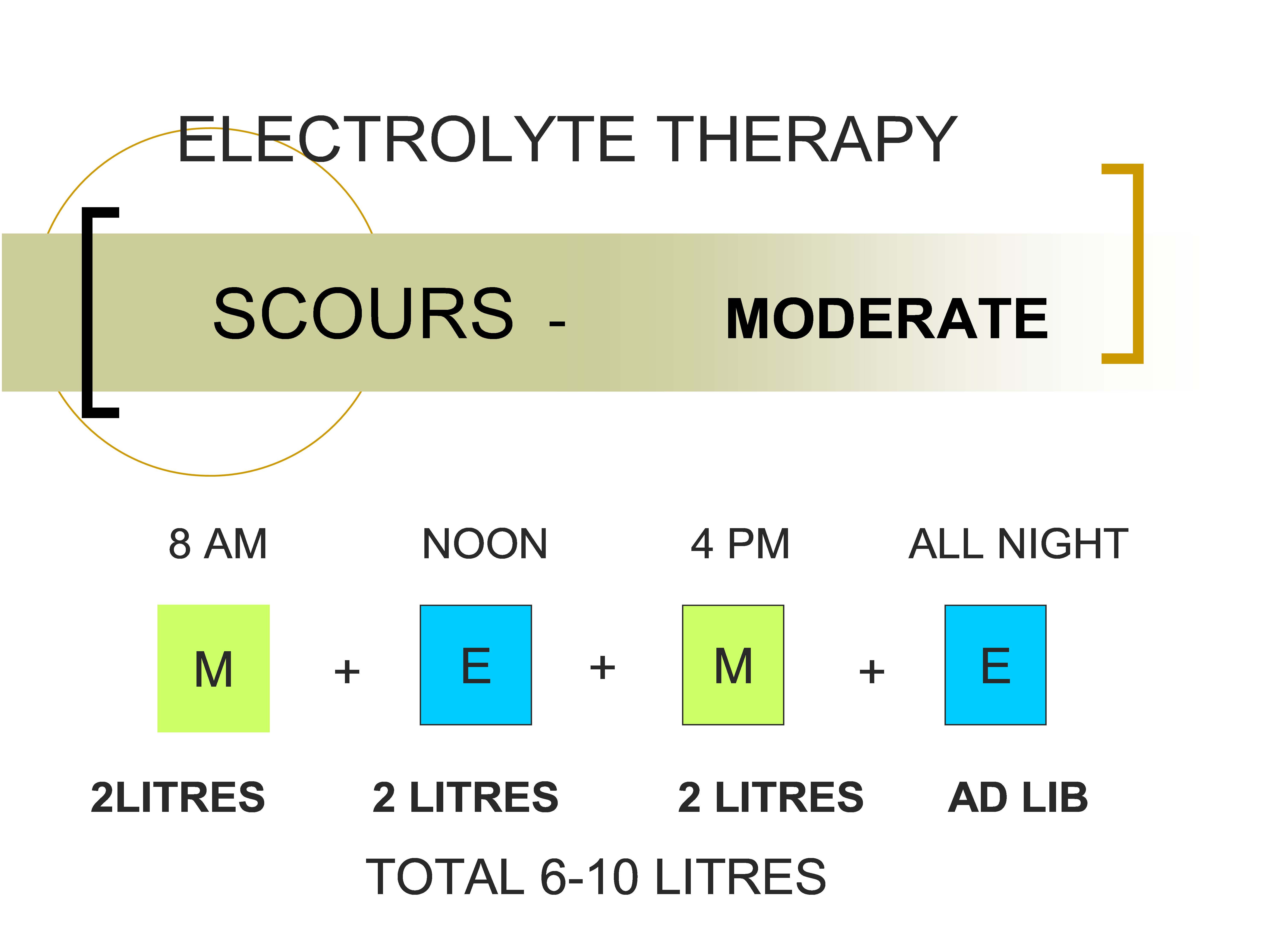
This regime shows that milk feeding should be continued as before on a twice daily basis at the rate of 1-2L/feed.
The electrolytes are then offered in 2L doses every 4 hours. Note that the electrolytes are offered AD-LIB ALL NIGHT LONG. The total fluids for the day is 8L+.
Recovery is usually uneventful, and the calves can be returned to full milk feeding within a day or two.
For severe scours a more aggressive regime of treatment is shown below (Figure 2)
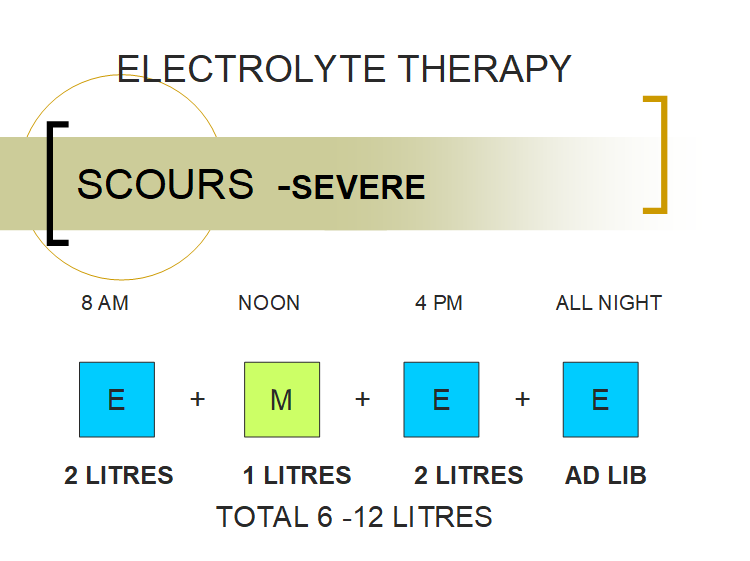
In the case of severe scours, milk is only offered once daily (to sustain the energy level), while electrolyte therapy is aggressive. Tube feed with warm milk (40ºC) if necessary.
Usually, the calves can then go onto the regime for moderate scours (Figure 1) by the next day.
Hospital Pens
The removal of the sick/scouring calf to a hospital pen is controversial. Why move or isolate them when their pen mates have already been exposed to the same pathogens?
A better option is to isolate them in a corner of the pen behind a gate for individual treatment. Chances are that in 2 days the calf will be back to normal and rejoin its pen mates. This is much easier to do, requires no lifting and socially is better for the calf.
If more than 25% of the calves in one pen are affected, it is best and simpler to treat the whole pen.
Supportive Therapy
As already mentioned in the previous article, there are several commercial products that are helpful in the treatment and recovery of scours, as follows:
- Sodium Bentonite, eg. Trufeed, Rumenite, OptiCalf.
- Probiotics, eg. Biostart or Rum-enzyme Plus.
- Biopect natural anti-scour
The use of antibiotic and scour mixtures containing antibiotics are seldom useful and should only be used after a veterinary consultation.
In summary
The treatment of calf scours is not daunting and need not be stressful.
Get an accurate diagnosis and start treatment early.
Full aggressive milk and electrolyte treatments will get the scouring calf back on track quickly and the results of treatments are very rewarding.