

Profitable calf rearing
Article supplied by Dr B.W. Schouten, BVSc
Veterinary Consultant to AgriVantage
Once you’re sure that your newborn animals have consumed a good amount of quality colostrum, the feeding schedule over the first 10-day period will lay the foundation for good early health and growth.
It’s important to consider the following:
- Feeding methods
- The amount to feed
- Feeding frequency and temperature of the milk
- The physiology of digestion
- Gut modifiers useful to aid digestion and gut health
Feeding methods
The drinking ability and speed of drinking varies hugely between calves and must be carefully monitored. Watch carefully over the first few days and separate the slow drinkers for extra attention; place them in a slow drinking group to ensure even milk intakes. Have patience with these calves – it is well worthwhile, and time well spent.
Teat feeders are the best, while compartmentalised feeders allow for greater control of milk intakes. Ideally, feed in groups of 5 calves with a 6-teat feeder, or no more than 10 calves on a 12-teat feeder. Small groups are easier to observe and are more restful for the calves – allowing you a greater chance of detecting disease problems earlier.
Bulk feeding in numbers above this is fine once calves are over 3 weeks of age and all drinking evenly.
The amount to feed
A calf requires a minimum of 10% of its bodyweight in fluids per day.
So, a 40kg calf needs a minimum of 4L fluids (milk) per day. Note that this is a minimum, not a maximum, as a calf will easily drink up to 6L (15% of bodyweight) if given a free choice. So, as a rule for maintenance and some growth, 4L is enough for smaller breeds and 5L for 40kg+ calves. In addition, all calves should always have adlib access to good, clean water.
For calves on a milk replacer (CMR) this means 4 x 125g/L = 500g of CMR/day.
As calves get older, the need for extra fluids also increases. So, a 60kg calf will require a minimum of 6L fluids – say 4L milk and 2L water - or milk intakes can be increased.
Where concentrated milk feeding systems are used (say 2L @ 200g/L), the need for extra fluids (water) becomes even more critical.
Feeding frequency and temperature of the milk
Feeding frequency has always been controversial. In my opinion, “twice a day” feeding for the first 10 days is always better, but after that “once a day” works well. For once a day feeding systems, milk concentrations should never be greater than 200g/L or the milk volume more than 5L/day.
Hot versus cold feeding is, again, controversial. There is no doubt in my mind that hot feeding (30-40ºC) always gives better results in those critical first 10 days.
Cold milk feeding should never be attempted where ambient night temperatures are less than 5ºC. Cold milk feeding costs the calf energy and slows the digestion of the milk - both not in the best interest of the young calf.
The physiology of digestion
The diagram below shows how milk is digested in the abomasum (fourth stomach) of the calf.
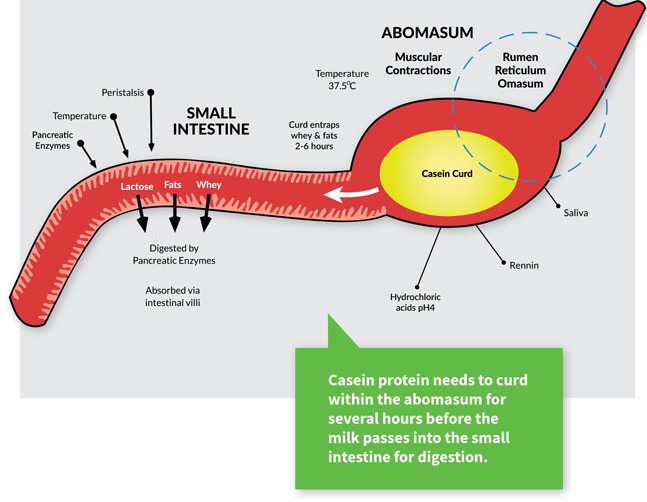
Milk passes directly to the abomasum and here under the influence of the saliva, the pH, rennin, body temperature and the muscular contractions of the stomach, a solid casein (milk protein) is formed in about 20 minutes. The casein curd entraps the lactose, fat and the whey for a while, but then releases those components to be digested and absorbed in the small intestine.
The casein curd never leaves the abomasum, it is digested and absorbed there.
If undigested casein protein enters the small intestine, a nutritional scour will result. The conditions where this is likely to occur are during periods of overfeeding, or when digestion is slowed by cold feeding. Therefore, “hot” feeding and twice a day feeding is physiologically easier for the young calf.
Gut modifiers useful to aid digestion and gut health
Several natural products can be used in conjunction with milk to aid the digestion of milk and settle the young gut. The best of these are:
- Natural yoghurt - both Acidophilus and Lactobacillus - available in the supermarket
- Biostart and Rum-enzyme plus – these are commercial products that contain probiotics and rennin to enhance the curding of the milk. Add to milk just prior to feeding and feed immediately as curding will occur within 5 minutes.
- Sodium Bentonite (Trufeed, Rumenite or OptiCalf) - these help to absorb fluids and slow the gut movements. Best given ad-lib in a trough from day one.
- Biopect - contains dried apple pulp to absorb fluids and to slow the digestion. Can be added to milk but will not cause the milk to curd.
All these products are helpful to make the digestion easier and reduce the incidence of early calf scours. Available from your rural stockist or vet supplies.